Showing posts with label Easy Syrian patriarch. Show all posts

Mar Yaqob of India(1301)


Mar Jacob(Mar Yaqob of India) was one of the legendary metropolitan of the Church of Malabar of St Thomas Christians.

So strong did the Christians of St Thomas become that, at a given moment, they aspired to independence and set up a line of Christian rulers of their own(villarvattom) which the rajahs of Cochin eventually absorbed shortly before the advent of the Portuguese[3][4]. Their metropolitan resided at Angamali near Cranganore and was assisted in the discharge of his office by an archdeaoon named by the Catholicos from the influential Pakalomattam family. Upon the metropolitan decease, the archdeacon assumed all his responsibilities and petitioned the said patriarch for a new substitute. It is not possible to paint a comprehensive picture of this fascinating and largely unknown chapter in the story of ancient Indian Christianity during the Middle Ages. The source material for this dark period which existed in the East Syrian repositories of Mesopotamia and in the old records of the Indian churches was destroyed by the Mongol hordes on the one side and by the Portuguese on the other. In fact the vandalism of the Mongol invasions of the Middle East was only surpassed in this sphere by the re-percussions of the Synod of Diamper in 1599. That act of faith simply led to the obliteration of all Indian records, since it was decided to burn all religious manuscripts tainted with the heresy of Nestorius.[2] Thus the historic records of Malabar church history passed out of existence. Cardinal Tisserant,however, registers a couple of minor but interesting references bearing upon the later mediaeval history of that church. The first dates from the fourteenth century, when a copyist named Zaccharias bar joseph bar Zaccharias made an allusion to the Catholicos Yahballaha III (1245–1317) and to Mar Jacob, bishop of India, in 1301.[1][5]

The dating formula in the colophon to a manuscript copied in June 1301 in the church of Mar Quriaqos in Shingly mentions the patriarch Yahballaha III (whom it curiously describes as Yahballaha V), and the metropolitan Yaʿqob of India(described as ‘vicar and governor of the seat of the apostle Thomas’, and probably the bishop Yacqob mentioned as the scribe’s tutor).. Chingly , described in this manuscript as 'the royal city', was doubtless the metropolitan seat for India at this time. The scribe was the fourteen-year-old deacon Zakarya, son of Joseph, son of Zakarya, who is described as ‘the pupil of the bishop Yacqob’.[5][11]
The colophon of the manuscript suggests the on-going relationship between the churches of Seleucia-Ctesiphon and Malabar [6][7]& Also consciousness of St Thomas Christians about their apostolic origin (One important aspect of the identity of the St. Thomas Christians was and continues to be their consciousness of their apostolic origin).[8]

“This holy book was written in the royal, renowned and famous city of Chingala  in Malabar in the time of the great captain and director of the holy catholic church of the East.. our blessed and holy Father Mar Yahd Alaha V and in the time of bishop Mar Jacob, Metropolitan and director of the holy see of the Apostle Mar Thoma, that is to say, our great captain and the director of the entire holy church of Christian India”[5][9][7][10]

The language used by the scribe about the patriarch Yahballaha III, however, is intriguing. The dating formula reads as follows:
“when the great governor, the holder of the key of the Holy Apostolic Church of the East and the bright lamp illuminating its territories, the chief of the chief priests, the father of fathers, our blessed and holy father, was Mar Yahballaha the Fifth, the Turk, catholicos-patriarch of the East, the chief region of the world, which guides and illuminates the other regions; who stands above the Catholic Church like a lamp stand to give light to all its servants and to dispel its fears.”[5][7][9]


It is interesting to see the superiority of the East over the West upheld in this formula, as three years later, in 1304, Yahballaha acknowledged the primacy of the Roman Church.[12] Protestant and Catholic scholars have long disputed the significance of this acknowledgement. It made sense for Yahballaha to cultivate good relations with Rome, but the recognition by the Church of the East of the primacy of the See of Saint Peter did not, in the eyes of the East Syrians, give the Western church the right to dictate their beliefs. The colophon of MS Vat Syr 22 is an interesting indication of how the East Syrians really saw themselves at this period.
But there is one puzzling aspect of this colophon. It is not surprising to find the Ongut patriarch Yahballaha III referred to as a ‘Turk’. But it is surprising to find him referred to as ‘Yahballaha the Fifth’. The standard lists of the Easy Syrian patriarchs know only two earlier patriarchs named Yahballaha, viz. Yahballaha I (415–20) and Yahballaha II (1190–1222). None of the known anti-patriarchs was named Yahballaha.

About the same time unexpected circumstances provided for a while the Indian Church with western contacts.Two of those visitors stand out as particularly important from the View-point of inter-Christian relations. The first was the Dominican friar Jordan Catalanl of Sevcrar: [d.c. 1336), who after the first stay in India prompted Pope John XXII (1361-44] to establish at Quilon the first Latin-rite diocese in the sub-continent.[13] It was however a very short-lived attempt. The second was the Franciscan and papal envoy. John de Marignolli. who stayed in Quilon for sixteen months In 1348-49.[14]
Their reports as well as those of other such casual visitors help us somehow to get at a clearer picture of Eastern Christianity in India in these centuries. In the 1320s the anonymous biographer of the patriarch Yahballaha III and his friend Rabban Bar Sauma praised the achievement of the Church of the East in converting 'the Indians, Chinese and Turks'.[15] India was listed as one of the Church of the East's 'provinces of the exterior' by the historian ʿAmr in 1348.[11]


NOTES:

[1]A History of Eastern Christianity (Taylor & Francis)-Page365

[2]The history of Christianity in India: Volume 2 By James Hough

[3]Eighteen Centuries of the Orthodox Greek Church(The separatist churches of the east )-Page 253, Quoted By A. H. Hore.

[4]A handbook of Kerala, Volume 1 -Page 152 Quoted by T. Madhava Menon, International School of Dravidian Linguistics.

[5]MS Vat Syr 22; Wilmshurst, EOCE, 343 and 391.

[6]Christian inculturation in India by By Paul M. Collins page 142

[7]Origin of Christianity in India: a historiographical critique By Benedict Vadakkekara

[8]Mathias Mundadan C.M.I., Indian Christians Search for Identity and Struggles for Autonomy, Dharmaram Publications, Bangalore, 2003, p. 2.

[9] The Christians of St. Thomas in South India and their Syriac manuscripts by J. P. M. van der Ploeg –page 187.

[10] The rise and decline of the Indian Church of the Thomas Christians by Placid J. Podipara page 15

[11]The ecclesiastical organisation of the Church of the East, 1318-1913, Volume 582 By David Wilmshurst-Page 343
[12] Phillips, p. 123

[13] Primary sources Of Jordanus' Epistles there is only one MS., viz. Paris, National Library, 5006 Lat., fol. 182, r. and v.; of the Mirabilia also one MS. only, viz. London, British Museum, Additional MSS., 19,513, fols. 3, r.f 2 r.

[14] Fontes rerum bohemicarum, iii. 492-604 (1882).

[15]Wallis Budge, The Monks of Kublai Khan, 122–3.

Mar Joseph Sulaqa (1554-1567)


Mar Joseph Sulaqa (Syriac: ܝܘܣܦ ܣܘܠܩܐ) was one of the last East Syrian bishops to Malabar. He was shortly followed by Mar Abraham; both reached in Malabar after the arrival of thePortuguese.Abdisho IV Maron(1555–1570), the successor of Shimun VIII Yohannan Sulaqa(Alias Mar John Sulaqa murdered in 1555), sent the brother of John, Mar Joseph, to Malabar as aChaldaean bishop; although consecrated in 1555 or 1556, Mar Joseph could not reach India before the end of 1556, nor Malabar before 1558, when the Portuguese were finally alerted by the presence of Mar Abraham and allowed Mar Joseph, accompanied by another Chaldaean bishop, Mar Eliah, to – very briefly – occupy his see, before the Inquisition also sent him to Lisbon in 1562.
The last two two Syrian bishops of Malabar were Mar Joseph Sulaqa and Mar Abraham; both arrived in Malabar after the arrival of the Portuguese.[1]
There is no doubt that Mar Joseph Sulaqa's appointment was canonical, for he, the brother of the first Chaldean patriarch Shimun VIII Yohannan Sulaqa, was appointed by his successor Abed Jesu and sent out to Malabar.Before that he was the bishop of Nineveh(Mar Joseph was consecrated Metropolitan by his own brother Patriarch John Sulaqa in 1554 AD)[2]).Mar Joseph was sent to India with letters of introduction from the pope to the Portuguese authorities; he was besides accompanied by Bishop Ambrose, a Dominican and papal commissary to the first patriarch, by his socius Father Anthony, and by Mar Elias Hormaz, Archbishop of Diarbekir.[1]

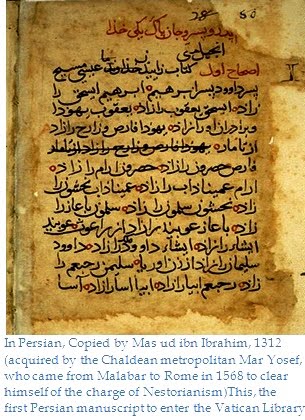
Gospel of Mathew in Persian
They arrived at Goa about 1563, and were detained at Goa for eighteen months before being allowed to enter the diocese. Proceeding to Cochin they lost Bishop Ambrose; the others travelled through Malabar for two and a half years on foot, visiting every church and detached settlement. By the time they arrived at Angamale war broke out. Then Mar Elias, Anthony the socius of the deceased prelate, and one of the two Syrian monks who had accompanied them, left India to return; the other monk remained with Archbishop Joseph Sulaka. For some time the new prelate got on well with the Portuguese and Jesuit missionaries, in fact, they praised him for having introduced order, decorum, and propriety in the Church services and all went harmoniously for some time. Later, friction arose because of his hindering the locally-ordained Syrians from saying mass and preaching and instructing his flock. Eventually an incident revealed that Mar Joseph had not dropped his Nestorian errors, for it was reported to the Bishop of Cochin that he had attempted to tamper with the faith of some young boys in his service belonging to the Diocese of Cochin. This came to the knowledge of the bishop, through him to the Metropolitan of Goa, then to the viceroy; it was decided to remove and send him to Portugal, to be dealt with by the Holy See.[1]

Accusing Mar Joseph for propagating Nestorian error they sent him to Portugal; arriving there he succeeded in securing the good will of the Queen, he expressed repentance, and by order of the queen was sent back to his diocese.[1]

[1] Rev. By 1567,Latin authorities asked him to make enqueries into the conduct and doctrine of the prelate suspected again for propagating nestorian error; in consequence of this the first provincial council was held and Finally, Mar Joseph who was forced to leave India in 1568 died in Rome in 1569, where his brother Sulaqa was consecrated as Patriarch 16 years earlier.His tomb has not been located so far.[1]

Eugene Tisserant (Roman catholic Cardinal) in his book Eastern Christianity in India comments on the pathetic end of Mar Joseph Sulaqa. Cardinal comments.

"Yet the measure of suffering was full, and Mar Joseph received, near the tomb of the Apostles, the crown which he had merited , through his long and slow martyrdom which was perhaps a more painful one than that of his heroic brother(Shimun VIII Yohannan Sulaqa)"[3]

Cardinal Eugene Tesserant, Eastern Christianily in India, Translated by E.R. Hambye, Culcutta:Orient Longmans, 1957,p.41.


NOTES:

[1] Encyclopaedia of sects & religious doctrines, Volume 4 By Charles George Herbermann page 1180,1181
[2]A general history and collection of voyages and travels, arranged in systematic order By Robert Kerr,Page 478
[3]Cardinal Eugene Tesserant, Eastern Christianily in India, Translated by E.R. Hambye, Culcutta:Orient Longmans, 1957,p.41.

Mar Yacob Abuna(1503-1553)

Mar Jacob Abuna(Mar Yacob) was one of the legendary metropolitan of the Church of Malabar ofst Thomas Christians.In 1503, the successor of Mar Simeon, Mar Elias, the Catholicos Patriarch of the Church of the East consecrated three Bishops from the Monastery of St Eugene- Rabban David as Mar Jaballaha, Rabban George as Mar Denha, Rabban Masud as Mar Jacob. Mar Elias sent these three new Bishops together with Mar Thomas to the lands of the Indians, and to the islands of the seas, which are within Dabag, and to Sin and Masin- Java, China and Maha china- Great China.[1][2][3]

Appointment of bishops for India, 1490–1503

At the end of the fifteenth century the Church of the East responded to a request by the Saint Thomas Christians for bishops to be sent out to them. In 1490,[4] two Christians from Malabar arrived in Gazarta to petition the East Syrian patriarch to consecrate a bishop for their church. Two monks of the monastery of Mar Awgin were consecrated bishops and were sent to India. The patriarch Eliya V (1503–04) consecrated three more bishops for India in April 1503. These bishops sent a report to the patriarch from India in 1504, describing the condition of the church in malabar and reporting the recent arrival of the Portuguese. Eliya had already died by the time this letter arrived in Mesopotamia, and it was received by his successor, Shemʿon VI (1504-38).[5]

The arrival of the Bishops in Malabar

On reaching India the bishops put in first at Cragnaoor, and introduced themselves as Christians to the twenty or so Portuguese who were living there. They were most kindly received, and helped with clothes and money.They stayed for about two and a half months. Before they left, they were invited to celebrate the holy mysteries after their own fashion: ‘They prepared for it a beautiful place fit for prayer, where there was a kind of oratory. on the Sunday Nosardel[seven days after Pentecost],after their priests had celebrated, The Bishops were admitted and celebrated the Holy Sacriiiee, and it was pleasing for the foreign missionaries.[3]

Accounts of foreign missionaries

Francis Xavier wrote a letter from Cochin to kingJohn III of Portugal on 26th january1549, in which he declared A bishop of Armenia (Mesopotamia] by the name of jacob Abuna has been serving God and Your Highness in these regions for forty five years. He is a very old, virtuous,and saintly man, and, at the same time, one who has been neglected by Your Highness and by almost all of those who are in India. God is granting him his reward, since he desires to assist him by himself, without employing us as a means to console his servants. He is being helped here solely by the priests of St. Francis Y. H. should write a very affectionate letter to him, and one of its paragraphs should include an order recommending him to the governors, to the veadores da fazenda, and to the captains of Cochin so that he may receive the honour and respect which he deserves when he comes to them with a request on behalf oft the Christians of St. Thomas Your Highness should write to him and earnestly entreat him to undertake the charge of recommending you to God, since YH. has a greater need of being supported by the prayers of the bishop than the bishop has need of the temporal assistance of Y.H. He has endured much in his work with the Christians of St Thomas.[6][2]

In that same year Francis Xavier also wrote to his jesuit colleague and Provincial of Portugal, Fr.Simon Rodrigues giving him the following description: »Fifteen thousand paces from Cochin there is a fortress owned by the king with the name of Ctanganore. It has a beautiful college, built by Frey Wcente, a companion of the bishop, in which there are easily a hundred students, sons of native Christians, who are named after St. Thomas. There are sixty villages of these Thomas Christians around this fortress, and the students for the college as I have said, are obtained from them There are two churches in Cranganore,one of St Thomas, which is highly revered by the Thomas Christians.[6][2]

This attitude of St. Francis Xavier and the Franciscans before him does not reflect any of the animosity and intolerance that kept creeping in with the spread of the Tridentine spirit of the Counter-Reformation which tended to foster a uniformity of belief and practice. It is possible to follow young Portuguese historians like joéo Paulo Oliveira e Cosca"s line of atgument, yet they seem to neutralize the Portuguese cultural nationalism in their colonial expansion and the treatment of the natives. However, documents brought out from the Portuguese national archives recently help to confirm a greater openness or pragmatism in the first half of the 16th century).[7][2]

Later years and death

It seems that about the year 1543 Mar jacob, feeling the weight of years,withdrew from active direction ofthe affairs ofthe Serra and settled in the Franciscan convent of St Antony in Cochin he had a long-standing friendship with the friars of that convent. Though not an outstanding leader, Mar jacob was at man of great integrity highly respected by all who knew him. ln a letter dated 26 january 1549 Xavier urges the king of Portugal to show him special favour.

One touching occurrence is related in connection with the death of Mar jacob. On his death bed he asked his friend Pero Sequeira to redeem for him the copper—plate grant recording the privileges oft the Thomas Christians,about which he had written to the king oI`Portugal in 1523, but which he had later given in pledge to a man in the interior for twenty cruzados. Before his death he had the happiness of knowing that this had been done.[8]

The first half century(1500-1550) of relations between the Portuguese and the Thomas Christians were, in spite of misunderstandings, on the whole marked by cordiality and good will. Mar jacob had maintained good relations with the Westeners throughout the long period of his episcopate, and was rewarded by the good opinions expressed by many concerning him.[8]


NOTES:

[1] Rev. H Hosten, St Thomas Christians of Malabar, Kerala Society papers, Series 5, 1929.

[2]"Christen und Gewürze" : Konfrontation und Interaktion kolonialer und indigener Christentumsvarianten Klaus Koschorke (Hg.)Book in German, English, Spanish, 1998 Page 31,32.

[3] A History of Christianity in India: The Beginnings to AD 1707 By Stephen Neill Page 194.

[4]more probably, as has been suggested by Heleen Murre-van den Berg, 1499).

[5]MSS Vat Syr 204a and Paris BN Syr 25.

[6]COSTELLIOE,Letters 232-246.

[7]Arquivio Nacional torre do Tombo Lisbo:Nucleo Antigo N 875 contains a summery of letters from india written in 1525 and also the kings replay to it :Cf.OLIVERIA E COSTA,Portughese,Apendice Documental 170-178.

[8] A History of Christianity in India: The Beginnings to AD 1707 By Stephen Neill Page 199-200